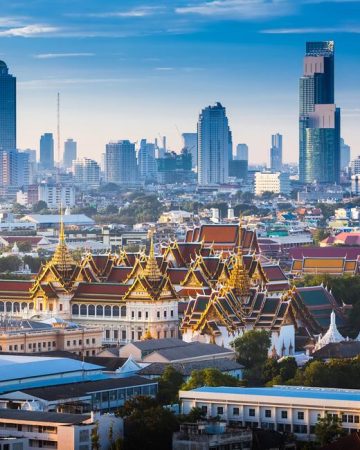
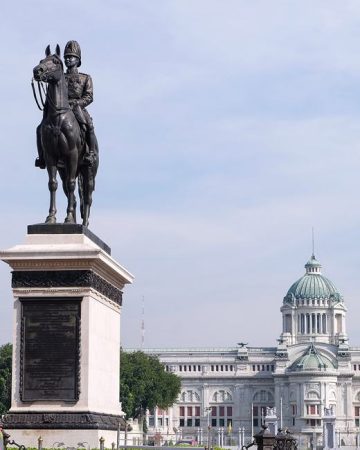
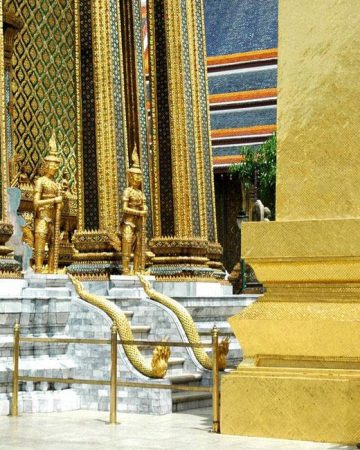
It would be difficult to sum up Thailand’s many culinary offerings, cultural icons, and adventures, but it’s safe to say that there is truly something new, unique, and authentic for everyone here. Jaw-droppingly beautiful beaches in Southern Thailand compete with the ultra-modern malls and sightseeing in Bangkok, catering for both beach-floppers and avid shoppers while true connoisseurs of history, culture and cuisine will find paradise in Thailand’s Northern cities and the serene Golden Triangle.
Nakhon Ratchasima (Khorat)
Nakhon Ratchasima or Korat Thailand is the most prosperous province of the East. Its richness of culture is very interesting since it has its own folk song called ‘Pleng Korat.’ Nakhon Ratchasima is also important to Thai history.
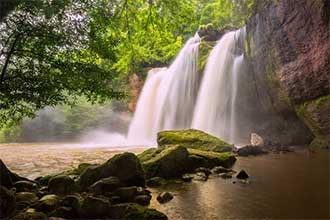
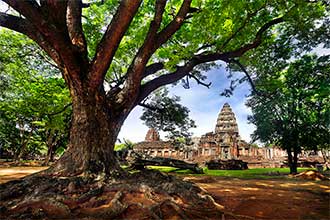
Locating a few hours away from Bangkok with easy transportation the province is very popular for tourists, especially in Khao Yai National Park. Khorat has fascinating traditions, charming hospitality, splendid natural scenery and awesome historical sites, including Khao Yai, Thailand’s oldest national park and newest World Heritage site, and the Khmer temple at Phimai, an important provincial capital of the Angkor Empire.
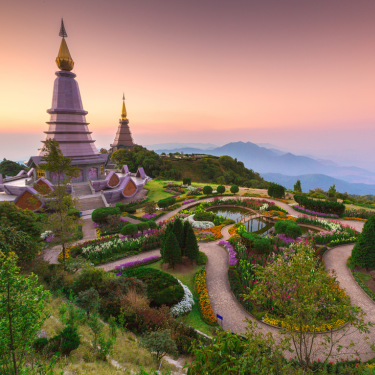
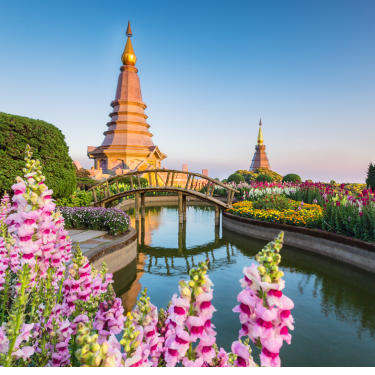
The cool weather and hilly climate of the Northern Province of Chiang Rai make it the perfect place to grow many different types of flower and plant that wouldn’t normally be found in Thailand.
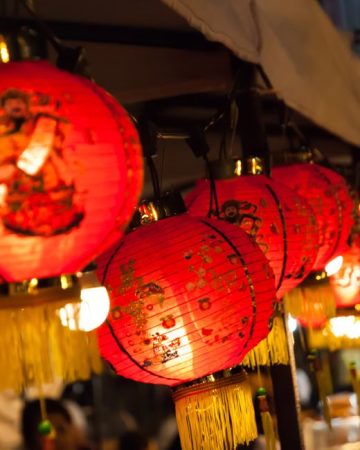
There will be ‘khom’ or lantern displays at the event so the gardens can be enjoyed night and day.
As well as the elegant beauty of the flowers, there will be different activities to enjoy, including a photo contest, flower painting competition, cultural shows, local product and food fairs, and musical performances.
Bo Sang Umbrella & Sankhampaeng Crafts Festival
January
Bo Sang & Sankhampaeng, Thailand
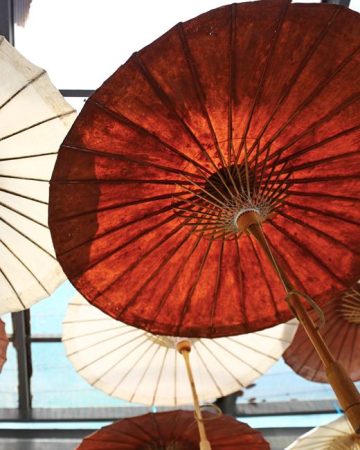
Bo Sang and neighboring Sankhampaeng are famous throughout Thailand for producing handicrafts and traditional umbrellas. This cultural heritage is celebrated with an enjoyable, low-key festival always well-supported by the local community. The event in Bo Sang takes place a few weeks before the Chiang Mai Flower Festival. Although it may not attract anywhere near the same number of visitors, the Bo Sang festival’s intimate nature gives it an unbeatable charm.
Chiang Mai Flower Festival
February
Chiang Mai, Thailand
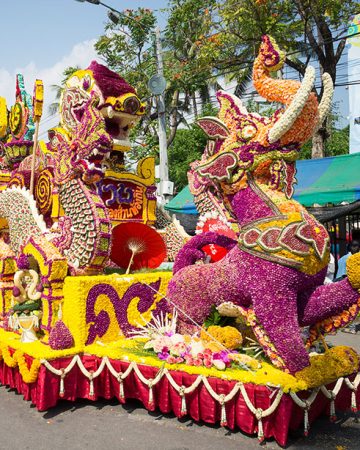
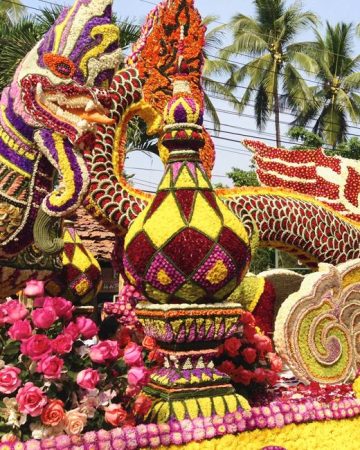
The northern Thai city of Chiang Mai celebrates the annual Chiang Mai Flower Festival at the beginning of February. This is truly a very impressive festival, with astounding floral displays, parades, music concerts, and street markets. All this preparation makes this one of Thailand’s most colorful and family-friendly festivals, with almost endless activities and sights to enjoy. Throughout the three-day festival, the old city of Chiang Mai is delicately decorated with beautiful flowers and flora. Visitors flock to see incredible exhibitions of Chiang Mai’s most vibrant floral displays, including truly special, locally-grown orchids. The festival also features a parade showcasing the region’s vibrant and colorful flowers, as well as dancers in traditional costumes.
Chinese New Year
February
Nationwide, Thailand
In Thailand, Chinese New Year is a holiday for Chinese people. Also called “Lunar New Year” or “Spring Festival,” this holiday is the first day of the New Year on the Chinese Calendar. Huge block parties rock Bangkok’s Chinatown, with many events centered around the Odeon Gate. Many will wear red and peruse the area for fun, food, and unique shopping. Unlike in many countries, holidays are no time to close in Thailand; staying open allows everyone to do more business!
Makha Bucha Day
February
Nationwide, Thailand
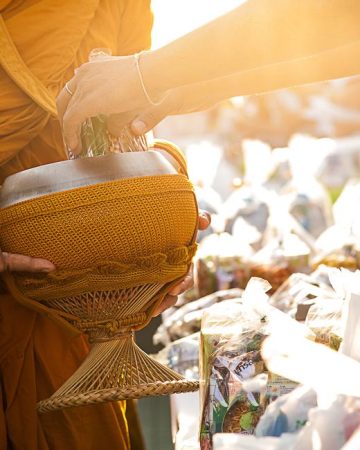
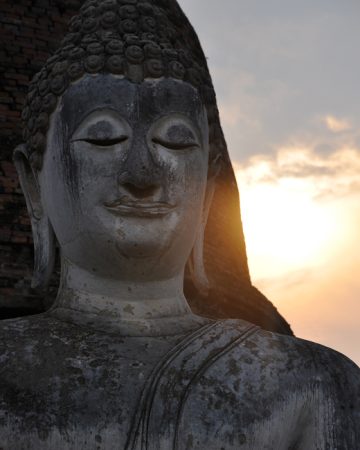
Makha Bucha Day is a Thai Buddhist holiday held during the third lunar month when Buddha is said to have delivered certain of his teachings. In Thailand, devotees head to Buddhist temples on Makha Bucha Day to participate in rites and “earn merit.” They may also abstain from alcoholic beverages, give food offerings to monks, meditate, and participate in a late-night candle procession.
National Thai Elephant Day
March
Nationwide, Thailand
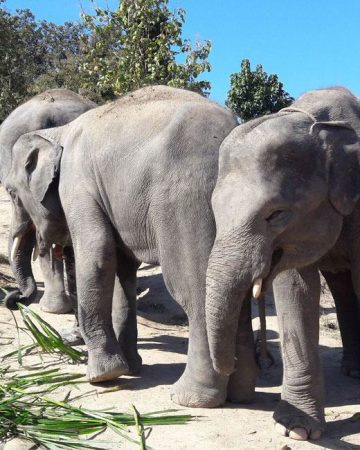
The elephant is one of the enduring symbols of Thailand, with the Thai elephant (chang) playing a pivotal role in the history and culture of the country. In 1998, Thai authorities decided to formally recognize the significance of the animal by designating March 13 as National Thai Elephant Day. On this day, various events occur in zoos and elephant parks throughout the country, with some parks treating their elephants to huge banquets of fruit and sugar cane. In some cases, Buddhist ceremonies will be held with the aim of bringing good luck for the elephant and its mahout (handler)
Chakri Day
April
Nationwide, Thailand
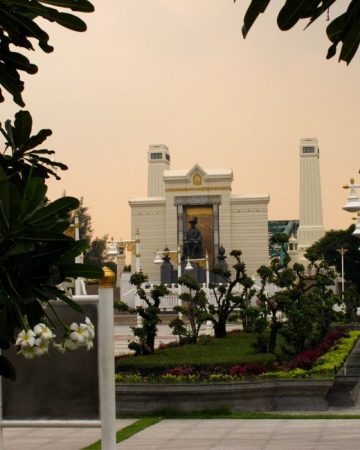
Thailand observes Chakri Memorial Day to celebrate the founding of the still-reigning Chakri Royal Dynasty, which dates back to 1782 and is the date of the coronation ceremony of Rama I. This is an important day to take the time to honor and remember all of the contributions of the Chakri kings throughout Thailand’s history. If April 6th happens on a weekend, the holiday will be observed on the following Monday instead. It was soon after the founding of the Chakri dynasty that its first king, Rama I, made Bangkok Thailand’s capital city. So, the holiday certainly has special significance to the residents of Bangkok. Today, Rama X, the tenth Chakri king, still reigns. He and the royal family oversee special services at the Royal Chapel on Chakri Day. They also visit the Royal Pantheon to honor the memory of earlier Chakri kings and lay a wreath by the statue of Rama I.
Songkran Festival
April
Nationwide, Thailand
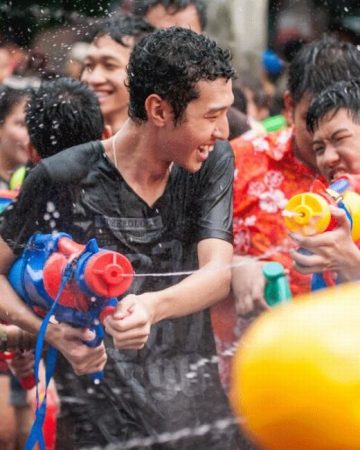
The Songkran Festival a national holiday in Thailand, marks the beginning of the Thai New Year. Songkran is also known as the “water festival,” since water is used to ritually wash away negativity from the previous year. Those celebrating Songkran pour water over one another, symbolizing the washing of bad luck and sins from life. Some even add herbs to the ritual water, as well.
The most famous street party in Bangkok is called Silom, which stretches a staggering 4 kilometers. Thousands of people, armed with water guns, balloons, and any other vessels they can get their hands on, will utterly drench anyone in their path.
Visakha Bucha Day
May
Nationwide, Thailand
Visakha Bucha Day commemorates the three major events in the life of Buddha: his birth, his enlightenment, and his death. In Thailand, Visakha Bucha Day is when the devout visit local temples to “do things of merit” by giving donations and engaging in various Buddhist rituals.
Thai law prohibits the sale of alcoholic beverages on Visakha Bucha Day, which causes many bars to close temporarily. Many of these celebrations are private and religious, but tourists are allowed to visit most temples around Thailand to catch a glimpse of the celebrations.
Phi Ta Khon Festival Day
Annually in June
Isan, Thailand
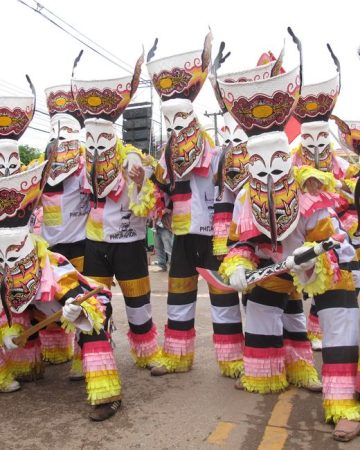
Every year, the Dan Sai district in Thailand’s Isan region stages an event called Phi Ta Khon, also known as “Bun Luang” or “Bun Pawat.” The event has its origins as a fertility festival, but these days, it has become an integral part of a two-day, “merit-making” event.
A colorful parade, Phi Ta Khon’s most vibrant event or “Ghost festival”, features locals dancing and striking poses while wearing huge, coconut-tree-trunk masks, topped with wicker sticky-rice steamers that make them appear taller and almost otherworldly.
Ubon Ratchathani Candle Festival
July
Ratchathani, Thailand
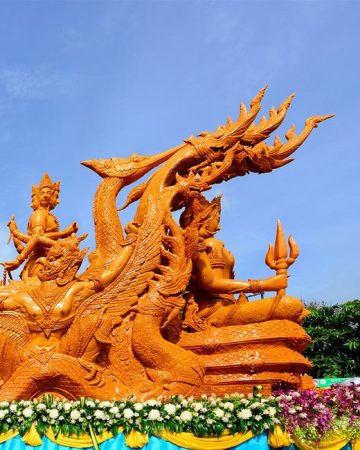
The Ubon Ratchathani Candle Festival celebrates two important Buddhist events: Asahna Bucha and Khao Phansa. The exact date of Asahna Bucha varies from year to year, depending on the lunar calendar, but usually falls in July. Asahna Bucha marks the day when the Lord Buddha delivered his first sermon at Benares in India. The day after Asahna Bucha is known as Wan Khao Phansa, and marks the start of the three-month ‘Phansa Rains Retreat’ period, which is sometimes referred to as “Buddhist Lent.”
King Vajiralongkorn's Birthday
July
Nationwide, Thailand
The birthday of King Maha Vajiralongkorn, also called King Rama the Tenth, arrives every 28th of July, and is a very important public holiday in Thailand. King Rama X has reigned in Thailand only since 2016, when his father, King Bhumibol, died after a 70-year reign. Vajiralongkorn was a clear successor, since he was Bhumibol’s only son, yet already 64 years old upon ascending the throne.
Chulalongkorn Memorial Day
October
Nationwide, Thailand
Chulalongkorn was born into the House of Chakri as the son of King Rama IV, and, even as a child, held a position in the royal court of Siam. Along with his political upbringing and eventual experience, Thailand’s most beloved leader also learned much through formal schooling. As a student, he studied biology, swordsmanship, engineering, English, and anthropology, making him a beloved King and an extremely accomplished one.
His Majesty the Late King's Birthday
December
Nationwide, Thailand
December 5th is a public holiday in honor of the late king, His Majesty King Bhumibol Adulyadej. The Thai monarch was born on December 5th, and this date is also celebrated as “Father’s Day” in recognition of the man fondly and respectfully regarded as the “Father of The Nation.”
Constitution Day
December
Nationwide, Thailand
Constitution Day in Thailand is a day to remember the adoption of the country’s first permanent constitution in 1932. In Bangkok and throughout the country, there are Constitution Day parades, fireworks shows, and numerous representations of Thailand’s present and past kings on display everywhere, ending the Gregorian New Year on a patriotic note.